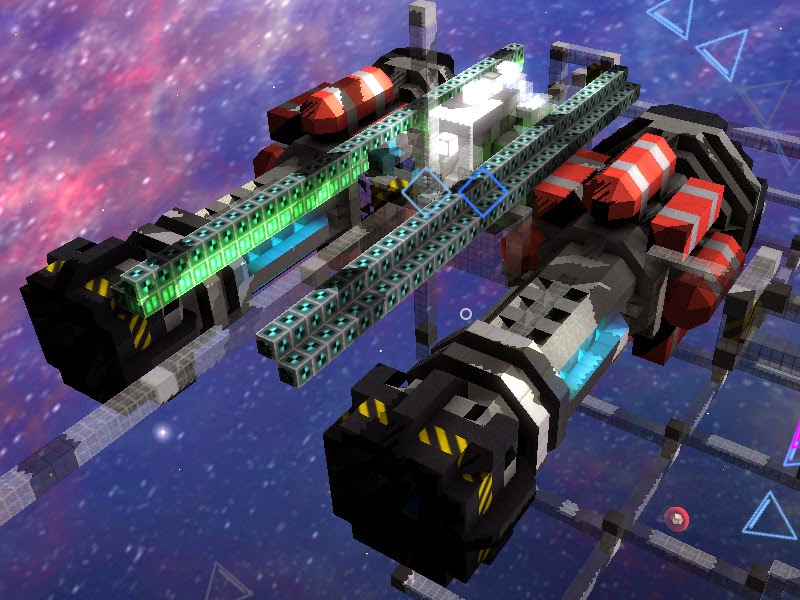
Showing posts with label CRV Alannis. Show all posts

Thursday, February 5, 2015

Deep Space Scanner

Having stumbled on a couple of pirate bases and hundreds of raider vessels while flying various ships, it became obvious that the surrounding space was filled to the gills with bad guys.

While I was apparently able to dispatch these guys with relative ease now using FRG Thor and even CRV Alannis, they still caused me headaches in SVG Excavator and SVG Speeder (although I almost never took her out any more, as she was now obsolete).

In addition, I knew that somewhere out there was a force of ships large enough to blockade the Trading Guild, which were far larger and stronger than my own empire.  Therefore the raider force must be pretty significant.

So it became desirable to locate and map other bases, and either avoid them, negotiate with them, or wipe them out... which I was becoming quite good at, it seemed.

I made plans to build a large deep space scanner.

Scanner scaffolding braces the structure while it is being built.
The scanner would be able to scan 4 sectors in all directions for enemy vessel activity, and scan the entire star system for bases and derelict space craft.  The Trading Guild advised that their own bases employed a cloaking system that bypassed the Geiger signature detected by the scanner, so their own structures would remain invisible to me.

The underside of the docked structure requires its own power and data feed to the station's core.
An independently docked structure, the scanner extends far above the station.
The scanner is docked to the station as an independent structure... effectively it's a vessel.  The station's own Geiger resonance needs to be isolated for the scanner to work, so attaching it directly causes the scanner to fail, requiring that it is its own structure.

Having it separate like this also will allow it to be undocked and moved as Dry Station expands and grows over time with new additional structure.

The scanner towers above the rest of the station, giving great penetration into deep space.
Once the device was fully operational, I engaged it and performed it's first scan of the system (hit P in game to see system/galactic map).

To my great surprise other bases began popping up on the monitors throughout the system... it seems I was surrounded by structures not my own...

My local sector had only my own Dry Station, the local Trading Guild shop and my own vessels in it.

My local star was smothered in other structures... enemy or derelict was unknown at this time.

My star is one of very many in the local area.

After some few hours of scanning telemetry, the device's systems were able to plot every star and wormhole in the entire galaxy... I was an insignificant speck in a sea of stars.
It was time to scout and map every one of those structures in my local space, to identify if they were enemy, friendly, or derelict.

Saturday, January 31, 2015

Docks and cargo siphons

During the final stages of building FRG Thor, one of the key things I found was that having ships drifing nearby Dry Station was awkward and somewhat cluttered.  Additionally it was both slow and inconvenient to do several astronaut trips between a newly returned vessel and the station's Factory, using my own personal data banks as a shuttle to carry digital mass signatures to my facility.

So I drafted plans to build a dock at Dry Station and fit it with a system that would automatically siphon digital signatures from a drop box next to the docked vessel, so that I wouldn't have to travel any distance and therefore save me a bunch of time.

Dry Station with her initial compliment of docking arms fitted.


The docking arms were a continuation of Dry Station's simple and inexpensive alloy mesh structure acting as a support for the mammoth cables required to transmit digital matter signals.  e=mc2, which meant that even small amounts of matter converted into monstrous amounts of energy.  All that energy required very heavy duty cabling to avoid being burnt out during transmission and storage.

At the end of each docking arm I've fitted a drop box connected to the central factory matter signature storage facility.
The docking arms were capped with a labelled drop box into which I could drop all matter signatures without having to travel the distance from the docked vessel to the factory myself.  From the drop box the signatures are siphoned down the heavy duty cabling to a central storage box, which in turn feeds all matter signatures into the sorting box.  The sorting box (which has until now been my overall drop-box) then distributes matter signatures into various sorted boxes to make finding and accessing them much easier.

Thor requires the biggest docking arm to date due to her size.

Different coloured cabling leads to different docking arms.
Red is SVG Speeder's docking arm cable.
Yellow is SVG Excavator's docking arm cable.
White is CRV Alannis's docking arm cable.
Orange is the recently added docking arm cable for FRG Thor.

Black cable is for a recently wired in scanner complex.
The central siphon box is connected directly to the power grid to cope with the humongous quantity of energy required.  Matter signatures can be drained from all siphon boxes simultaneously and then fed at a steady pace into the factory's sorting box.

The entire set up allows me to disembark a newly docked vessel, and drop all matter signatures into the siphon box immediately adjacent to the docked ship.  From there Dry Station will automatically draw it into the matter signature facility and sort it into it's necessary home.  Whenever a new matter signature is encounted that does not have a home yet, it remains idle in the sorting box, and this acts as a prompt for me to either re-configure an existing storage box to receive it, or create a new storage box for that catagory of matter signatures.

The entire set up makes life much easier for me, and ensures that the factory always has a precise location to draw any particular type of matter signature from.


Sunday, January 25, 2015

The Library

As time went on I found that one thing tended to lead to another.

For example the build of FRG Thor required me to use particular types of components (for example shield capacitors), which in turn required particular types of materials (for example Rammet and Sertise capsules).

As I had since breaking free of the now obliterated Gundabadt, I had been purchasing materials and even components from the nearby Trading Guild station, however the station was having supply issues due to pirate blockades in a nearby system, and were unable to provide me any more than I had already purchased.

As a result, I was reaching a point where more and more items were now unable to be built or purchased, and the only way I would be able to build these items for any more vessels and expand my budding empire would be to mine and process the minerals myself.  Or destroy the blockade.  If the Trading Guild couldn't despatch the blockade, then clearly I would have no chance, so really, the only option was to find, mine, and process the necessary minerals myself, and use them to manufacture my own items.

But I was new to this, having been a process slave in Gundabadt I knew nothing about minerals, asteroids, what they looked like, where they could be found, et cetera.

I would need to begin exploring, sampling, and cataloging my discoveries.

I knew this would require a huge amount of processing power, and so the concept for a Library addition to my shipyard station was born.

Databases and servers whir and blink as they wait to absorb, catalog, and as required present compiled information about the discoveries I made.
Everything from asteroids found, mineral content, resources, capsules, refineries, technologies, building techniques, blueprints for ships, research, starbase and asteroid field locations, and a host of other information would be fed into these servers and processed by their AI into a range of useful information.

Connected to the main deck of my shipyard and the basic factory I had previously built, the library is almost as power-hungry as the entire shipyard and factory to date, warranting the addition of another 2 3x3x3 power generators.

To protect the delicate servers from random pirate fire, the Library has a much denser structure than the rest of the shipyard's facilities, and is wired directly into the power grid.
This Library Wing adds a further 10x5x10 structure to the basic factory and power/shield generator grid structure connected to the shipyard, and is helping to form a small station attachment to the entire structure.

With the docking arms (completed with ship maintenance systems and cargo siphons) added to the station some weeks ago, the entire shipyard complex is becoming much more like a small station now.

Dubbed "Dry Station", my shipyard was almost a small port nowadays.
Pirates seemed to give me wide berth these days, although occassionally a sniper or two would sit outside the range of my homing missile turrets and pepper Dry Station with long shots... but they did little more than give me a smirk if one managed to actually strike the base instead of sail by through empty space.

Saturday, January 17, 2015

SVG Excavator

SVG Speeder was a good salvaging vessel.  She wore four of my automated homing missile turrets and could soak up a reasonable asteroid in a few minutes.  She had been created from my initial credits which I'd managed to obtain during my escape from Gundabadt Station, and had served me well in digitising asteroids for their mineral content.

However as my need to build bigger and greater vessels increased, so too did my need to digitise minerals (both from defeated pirate vessels, as well as asteroids and comets).

So it became time to replace Speeder with a much more powerful salvaging vessel.

I drafted plans to incorporate the shield technology I had developed for the corvette Alannis, as well as banks of well powered salvaging cannons that would make Speeder's own capacity seem small and insignificant.

I also wanted the new salvager to have much tougher armour as I intended to drop the weight of turrets in favour of shields and armour and simply sit under the umbrella of turret emplacements as I claimed asteroid fields for my own.

And so I began building my new salvager, the SVG Excavator.

SVG Speeder shown to the right of the main salvage cores of SVG Excavator for scale
SVG Excavator has 2614 salvage cannons, compared to SVG Speeder's 240 salvage cannons.  In addition she has 212,000 power storage, with 458,000 e/sec recharge.

SVG Excavator's specifications:
Mass: 820.3 tons
Length: 42m
Height: 16m
Width: 27m
Thrust: 237.9 (-98)
Shields: 28000 (+319/sec)

CRV Alannis and SVG Speeder shown next to shipyard and SVG Excavator for scale.
SVG Excavator is much tougher than SVG Speeder

She has navigation lights for port, starboard, deck and dorsal.

She boasts 1x port, 1x starboard, 2x bow, and 1x stern observation lenses.

She has an armoured open core entrance, and an aligned docking camera.

Her engines are not as powerful as CRV Alannis, but more powerful than SVG Speeder.
SVG Excavator is a big step up from SVG Speeder, and will greatly speed up my mining and salvaging operations.

It was time to take her out for her maiden voyage.

Monday, January 5, 2015

The Battle of Gundabadt Station

Finally the corvette's armour was completed.  A thick top plate, and two side/dorsal plates protecting her engines and vital systems.

This armour is designed to serve as a backstop for when the shields fail under heavy fire.


After fitting the Alannis out with the homing missile turret design that I had built for my turret emplacements around the shipyard and factory, she was ready to take out.

I went looking for a fight.

Where better than to announce to Gundabadt that my space was not only defended but that it represented a threat if attacked.  I turned my navigation computer to the Gundabadt Station, drifted out of dock, and then engaged full throttle for my target waypoint.

Testing my shields, escape pod (I had Taxi docked for now), engines, radar jamming, and all other systems on the Alannis while en route.  Everything performed marvelously, and I was ready to hunt some pirate fighters and maybe even put a dent in the station itself.

Some distance away the station began to become visible, I engaged the AI controlling my turrets, and they automatically fired a full volley from every turret at the station.  No going back now...


As my missiles closed in on the station it sent out an emergency call for any nearby friendly to assist, and before long I found myself in the middle of a fire fight.


The skirmish lasted for nearly 15 minutes and I quickly discovered that Alannis's shields were sorely lacking but that her armour offered her great protection from the beam weapons used by the pirate fighters. Their shots would destroy most armour cells they hit, but because of the movement of all the vessels in the battle it was very rare for their beams to hit the same area. So the armour as a whole soaked up a tremendous amount of fire, supported by the shields regenerating from time to time.

My homing missiles on the other hand took down target after target, usually only 1 or 2 missiles fired at a target was enough to pop it.

Before long I was swimming in overheating cores and drifting wrecks, and the station was completely disarmed and peppered with craters from my weaponry.


I explored the vacuum-ridden station in Taxi, plenty strong enough to withstand any small-arms fire that might have come from any suited survivors... as it turned out there were none.  The place was vacant.  I had completely squashed the station and inhabitants of a clan of pirates that had held me and my family prisoner for so many years.

Alannis had taken a beating during the battle, so we limped home for some much needed repairs.  She had fought well and proven to be far more effective than Gustav and SVG Speeder combined.  Alannis was not capable of salvaging any of the wrecks she peppered the battle field with, and her shields were woefully inadequate, but for my first corvette she had done well.  And nothing could distract me from the elation I felt at having destroyed my former prison station.

For the first time in my life I felt truly and completely free.

Friday, January 2, 2015

Cramped Quarters

Alannis's internal systems were now fully fitted and operational (except the turret systems and the rebuild of the escape pod damaged in the first pirate wave from Gundabadt Station).

While she looked naked without her armour, the Alannis was complete inside and technically able to to fly.  Totally without teeth, but able to fly.


Her internal systems include large dual ion compression engines, energy dispersal shields, an escape pod bay, front underside hatch access, rear shielded heat dispersal radiators, thick dorsal, starboard, and portside armour plates, 4x small homing missile turrets, 1x large topside long range beam turret, top and bottom front cameras, rear camera, port and starboard cameras, and internal access to all major systems for inspection and repair from within shields while under fire.

Alannis's central core and control room.
Hatch access is in the bottom starboard side of the control room, which accesses the turret and computing maintenance area, and from there a plex door exits directly into space underneath the ship within the protection of the shield and armour.

The main deck of Alannis.
Alannis's main deck has navigation and diagnostic computers and read-outs, medical facilities, shield and gravity control, and access all areas, including the front passageways leading to the port and starboard engine maintenance (shown in picture), the port and starboard rear reactor maintenance areas, the rear escape pod passage, and the turret and computing access way underneath the main control room.
Starboard engine maintenance access passage.
Standing at the white light shown on the right of the previous picture and looking down and back along the engine, this passageway accesses all the engines on the starboard side back to the reactor.
Port passage to the reactor access passageway.
Looking immediately port of the control room the shield and gravity control panels can be seen, and behind them the passage that leads down to the port side reactor.  A mirror image passage (with slightly different systems lining it) exists on the starboard side also.
Escape Pod Bay inspection port
Standing in the passage shown in the previous image, an inspection port can be used to view the condition (or observe the docking) of small craft in the escape pod bay.
Portside reactor inspection passageway.
One of the reactor's tanks is visible on the right, with the various computer and fluid dispersal systems visible on the left and at the back of the passage.  An access metal grill hatch at the back of the passage allows a crew member to wriggle through to the rear heat-dispersal radiators if necessary.

Thursday, January 1, 2015

Recovery

The pirate attack shook me from my false sense of security.

Most of the damage to my systems seems to have been done by my own dumb-fire missile turrets, as they blindly tracked and fired at targets without paying any attention to any friendly structures in front of them.  Clearly my AI programming skills needed some serious work.

I set about rebuilding the damage as quickly as I could, and researched how to produce various systems besides my current dumb-fires.  Homing missiles with an increased firing range appealed to me, and I set about reconfiguring my turret design to accomodate.


After testing the new homing missile turrets on some remote destroyed turrets I outfit my shipyards and factory turret emplacements with them just in time for another wave of pirate fighters.  The homing missiles made short work of them, leaving several fighter husks drifting in space at some distance from the shipyard.

I used Taxi to retrieve them for reverse engineering, and before long I had 18 new fighter shells anchored near the shipyard, able to be studied and reclaimed at any time. All automatically shot down by my new turret systems.


I still didn't feel as though I had the fire power to attack the Gundabadt station safely, but at least it seems I was much better protected than I was before. I set about rebuilding Alannis's damaged systems and continuing her build.

Wednesday, December 31, 2014

Attacked!

Building ships requires materials.  Lots of materials.
Even though we live in an amazing age where matter can be disassembled, assembled, stored digitally, compressed, and converted into compounds, components, and parts in very small spaces, it could not be created from nothing.

So while I would rather spend my time building the Alannis, it became clear early on that I would need to retrieve far more materials from space than I had already mined.

I took a missile-turreted SVG Speeder out to known asteroid fields and soaked up rock.  And more rock.  And still more rock.

While mining Speeder's sensors detected two incoming pirate vessels, and her missile turrets opened up. Before long the pirates had called in re-enforcements and it was time to retreat back to the safety of my turret-defended shipyard and budding base.

But for every pirate vessel that got destroyed, three more appeared, and soon my shipyard and it's defenses of several missile turret emplacements were swarming with small pirate attack craft busily carving up my defenses.

The dumb-fire missile turrets did their best to predict the movement of the enemy craft, but only 1 in 20 shots landed... and although highly effective when they did hit, they didn't hit often enough to make a real impact.

Before long the pirates were taking down turrets and shooting up Gustav, SVG Speeder, Taxi and my shipyard too.  The Alannis took a small share of fire but the pirates seemed to be focusing on the active vessels and turrets... perhaps they felt the Alannis was worth salvaging rather than destroying.

By the time the smoke had cleared the pirates were gone, my turrets were completely destroyed, and my shipyard and budding factory had huge holes smashed in them.  Gustav's remains glowed hot and red.  It was a sad sight to see all my hard work all but destroyed.


I decided I would need much greater defenses.
Missiles were far more effective than lasers for the same materials and space investment, but they were slow and therefore often missed.  I would need to look into ways to make missiles that could track a target and hit it regardless of it's maneuvers.

Time to build some homing missiles and build a solid defense... the next attack would probably be much larger.

Engines and escape pod completed.

 Soon enough I'd finalised the engines, and saved their design as a template for future builds.


Once the engines were completed I moved on to the escape pod, nestled between the reactors. Downward facing at the stern, the escape pod bay would be hidden behind armor and heat sinks for the reactors, and would allow a rapid escape in the event of the the Alannis going critical.

The internal access to the escape pod is also completed, including lighting.  Wiring and consoles will be added later as systems are installed. The pod has a double-thickness blast door (pre-open ready for rapid escape), radar jamming that will last for nearly 15 minutes before needing a refit, and a strong inertial destabilisation propulsion unit, all underneath thick armor. It is an escape pod designed to escape in the middle of heavy combat.
On either side of the chassis the main power systems are currently being installed.  These will drive the Alannis's shields, radar jamming, and weapons systems.